5 Signs Your Child Needs a Home Tutor
Every parent wants to see their child succeed, but navigating the academic journey can sometimes feel overwhelming. With increasing classroom sizes and fast-paced curriculums, even the brightest students can occasionally fall behind.
While a single bad test score isn't a reason to panic, a consistent pattern of struggle might indicate that your child needs specialized, one-on-one support. A dedicated home tutor can bridge the gap between classroom teaching and your child's unique learning style.
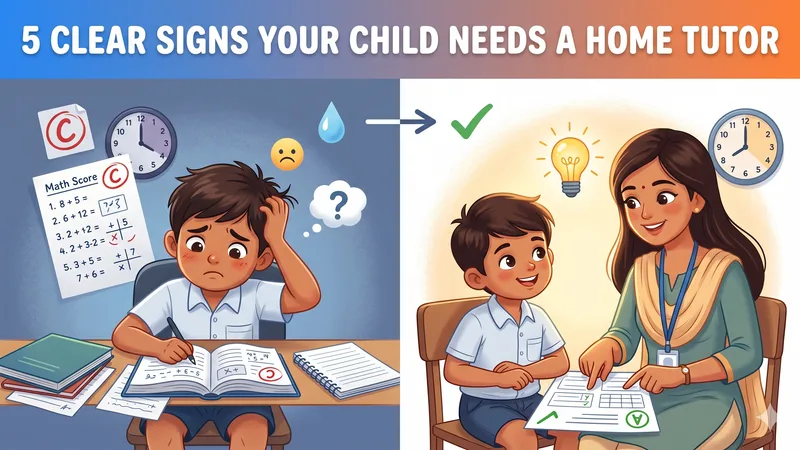
Here are five clear signs that it might be time to bring a home tutor into your child's educational routine.
1. A Consistent Decline in Grades
The most obvious indicator that a child is struggling is a steady drop in their report card or weekly test scores.
- Look for patterns: An isolated poor grade on a tough physics quiz is normal. However, if you notice a continuous downward trend over several weeks or months in a specific subject—or across the board—it's a red flag.
- The compounding effect: Subjects like math and science are cumulative. If a student misses a foundational concept early in the semester, subsequent lessons will feel impossible to grasp. A home tutor can diagnose these knowledge gaps and rebuild the foundation.
2. Homework Battles and Avoidance
Homework shouldn't be a nightly battlefield. While it's natural for kids to prefer playing over studying, extreme avoidance tactics often mask underlying academic anxiety.
Watch out for these behavioral shifts:
- Hiding assignments: Claiming they have no homework when you know they do.
- Prolonged sessions: Taking three hours to complete a worksheet that should take thirty minutes.
- Tears and tantrums: Experiencing visible distress, anger, or meltdowns when it’s time to open the textbooks.
A tutor removes the parent-child friction from the homework equation, providing a neutral, patient guide who can help break tasks down into manageable steps.
3. Loss of Confidence and Negative Self-Talk
Academic struggles rarely stay confined to the classroom; they quickly bleed into a child's self-esteem. If your child starts making defeating statements, it is time to intervene.
Listen for phrases like:
"I'm just not smart enough." "I hate school." "There's no point in trying, I'm going to fail anyway."
A skilled home tutor doesn't just teach syllabus content; they act as an academic coach. By celebrating small victories and providing personalized encouragement, they can help rebuild a student's confidence and shift their mindset from "I can't" to "I am learning how."
4. The Classroom Pace is Too Fast (or Too Slow)
Teachers do their best, but teaching a room of 30 to 40 students means they have to cater to the average pace. This inevitably leaves some students behind and leaves others bored.
- Falling Behind: If your child processes information differently, needs more visual examples, or simply requires extra repetition, the standard classroom pace will leave them feeling lost.
- Loss of Engagement: Conversely, if your child is not being challenged enough, they may zone out and lose interest in academics entirely.
Home tutoring offers a completely customized curriculum pace, ensuring the student thoroughly understands a concept before moving forward, or providing advanced material to keep a gifted student engaged.
5. You Lack the Time or Subject Matter Expertise
As students progress into higher grades, the curriculum becomes significantly more complex.
- The "New Math" problem: Educational methodologies change. The way you learned algebraic equations or language grammar might be entirely different from how it is currently taught, leading to confusion if you try to help.
- Time constraints: Between demanding professional careers, managing a household, and juggling extracurricular schedules, parents often simply do not have the dedicated hours required to effectively tutor their own children.
Delegating this responsibility to a professional ensures your child gets high-quality, focused instruction while allowing you to reclaim your role as a supportive parent rather than a stressed-out teacher.